WHY DEFENSESTORM
With the ever-evolving threat landscape and stringent requirements to prove cybersecurity compliance, it’s time to move to cyber risk management, the continuous process of preventing, detecting, assessing, and mitigating cyber threats.


Financial institutions operate in an environment of constant change, and, therefore, constant and evolving risk. You manage the risk associated with other areas of your business, such as loans and credit. Since the nature of these areas is dynamic and changing, a risk management framework is used to identify, measure, mitigate, monitor and report on the risk involved, in an on-going and never-ending cycle. We know that the same discipline must be applied to cyber risk management as it is uniquely dynamic, a result of two factors.
Cybercriminals are always on the watch, seeking out weaknesses that enable them to penetrate a financial institution’s defenses.
Expanded digital offerings, upgraded technology at existing branches or opening new branches, and even adding new employees are all reasons to celebrate change, but they all open the door to additional cyber risk.
Our solutions bring together advanced, AI-driven technology with a highly-skilled security operations team. You get integrated risk assessment, cyber security threat detection and proactive fraud prevention– all while ensuring you maintain and can prove regulatory compliance.
Managed through GRID Active, financial institutions can see the state of their cyber risk readiness through tools like the Cyber Risk Management Action Dashboard. This tool provides easy access and views actionable threats/alerts, clear actions to remediate, and a clear and strong understanding of ‘how ready’ the entire organization is against all types of threats.
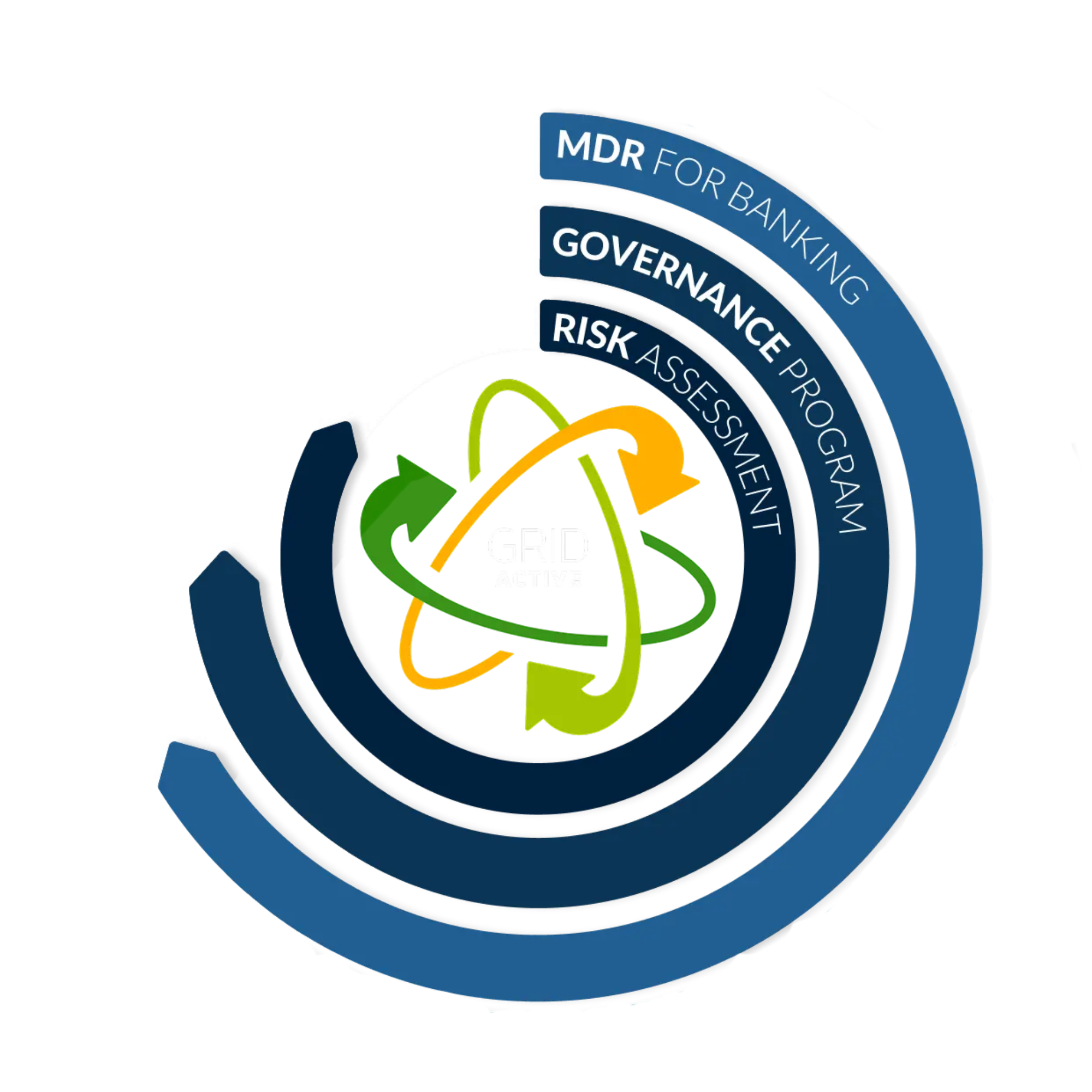

To strategically protect your most valuable assets and customer data, a defensive approach to cybersecurity is fundamental. However, your financial institution operates in an environment of constant change and, therefore, constant and evolving risk.
To address the constantly evolving risk landscape, you need to add an offensive approach to the traditional defensive state.
Cyber risk management is the process of preventing, identifying, assessing, and managing the risks associated with cyber threats and vulnerabilities. This includes understanding the potential impact of a cyberattack on your institution’s reputation, operations, and finances, as well as developing and implementing strategies to manage those risks. Designing a robust cyber risk management solution requires data from thorough and continuous cyber security risk assessments. This approach is essential to improve and maintain an efficient level of cyber risk readiness.
Generic cybersecurity solutions may look strong on paper, but for banks and credit unions they leave dangerous gaps. This blog exposes the illusion of “all-in-one” MDR services and explains why financial institutions face unique threats that generic models can’t handle.

Boards demand clarity on security, proof, and risk. Learn how banking-specific MDR delivers the metrics, evidence, and insight CISOs need to lead with confidence.
Great Lakes Credit Union (GLCU), located in Bannockburn, Illinois, manages $1.4 billion in assets, serves 111,090 members, and employs approximately 231 people. The credit union faced challenges with disjointed security and risk systems, limited capacity within a small security team, and manual, labor-intensive processes. These issues made it difficult to correlate data for actionable insights and expand cyber event monitoring, leading to inefficiencies in operations and delayed responses to potential threats.
